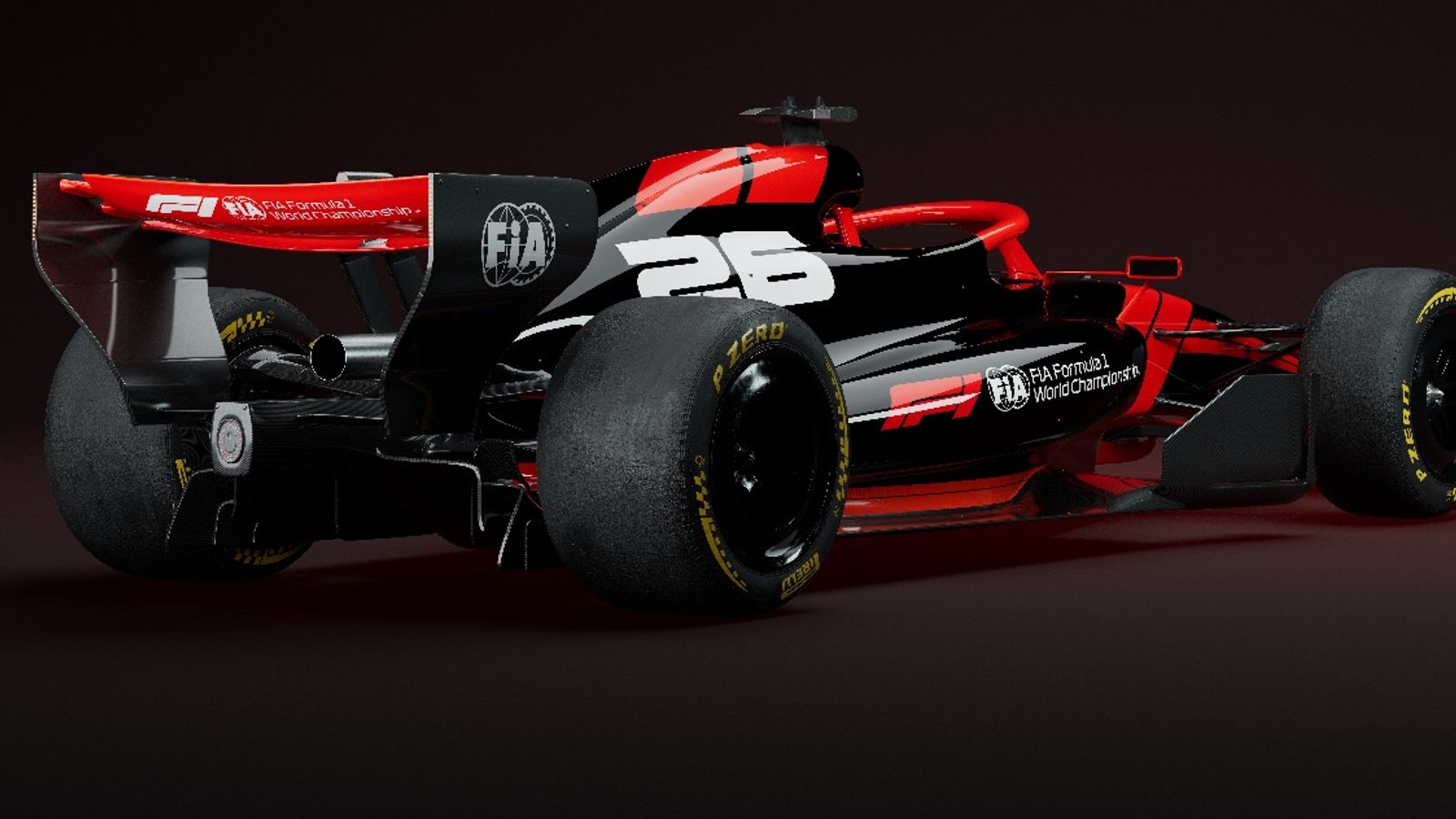
Formula 1 has announced "Overtake Mode" will replace DRS from the 2026 F1 season as part of a huge shakeup in the sport's regulations.
The overhaul, which Your Site F1's Martin Brundle has described as "the biggest ever", will include moveable front and rear wings on the cars, which is available to the drivers for every lap during a race.
The drivers will also have "Boost Mode" at hand which can be used at any point over a lap, where they push a button to deploy maximum power from the engine and battery - which will be made up of 50 per cent electrical power. This will be similar to the KERS system that was in F1 from 2009 to 2013.
F1 says the new car will give the drivers "more power in their hands than ever before" as they will need to understand how to extract the most lap time from the car over a single lap in qualifying and in a wheel-to-wheel battle.
DRS replacement, Overtake Mode, can only be used when a driver is one second behind another car through the detection point - as was the case with DRS. The extra power can be used all in one go, or spread over a lap, with F1 yet to announce how many seconds a driver will have available to them over a single lap to use Overtake Mode.
The combination of Overtake Mode and Boost Mode is expected to provide better racing, with the new cars also set to make it easier to follow another car.
Mercedes driver George Russell said: "I think you will see more overtakes next year, but more overtakes in obscure locations - in locations where we've never seen overtakes before.
"If a driver's at the bottom of their battery, and the one behind has more battery, in a given section of the track, they can suddenly jump past them at a corner in the past where there would never be an overtake. I think the 2026 regs will offer better racing."
The much-talked about moveable wings, known as "Active Aero", will be the most visible change in 2026.
The cars will run in a default mode for the corners where the wing flaps are closed to have more downforce but on designated straights, the drivers can engage "Straight Mode" which will open the wings to increase drag and increase top speed.
With higher top speeds, the braking zones will be bigger which should also aid overtaking so we may see the return of drivers outbraking one another from a long way back - a move Daniel Ricciardo perfected during his time at Red Bull.
The new power units will be 50 per cent internal combustion and 50 per cent electric, with the MGU-H (a power unit component) removed and MGU-K (a generator that captures electrical energy) power increased from 120kW to 350kW.
This may lead to drivers lifting at the end of straights to recover more electrical energy to the MGU-K so they can use that electric power out of a corner to accelerate. As a consequence, we may see some interesting racing scenarios.
If one driver is lifting into braking zones and another is not, we could see drivers from a long way back suddenly going down the inside of the car in front.
Williams driver Alex Albon said: "Look at Formula E as a more extreme version as to where we're going to go to. You can see how the drivers manipulate the racing and qualifying and how they deploy and all these kind of things to gain performance.
"It's not going to be that extreme, but there will be an element of the drivers who have the brain capacity to understand and facilitate all these demands will go well.
Watch every race of the 2026 F1 season live on Your Site, starting with the Australian Grand Prix from March 6-8.
